
From Service to Career
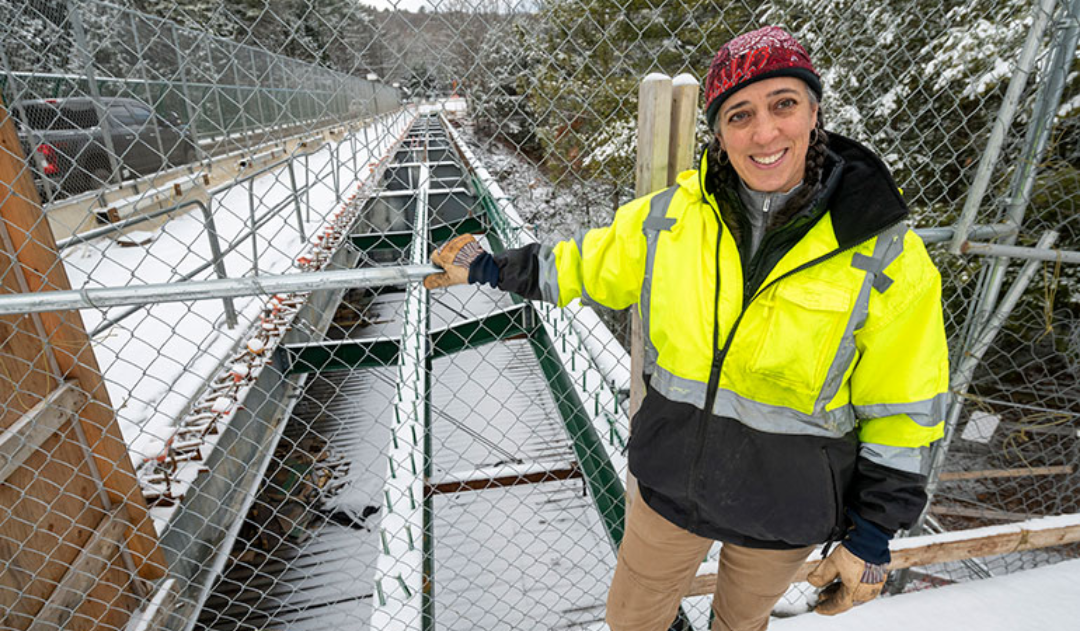
A reporter for Vermont Biz interviewed program participants from the Serve Learn Earn workforce development collaborative made up of four Vermont non-profits including Vermont Works for Women, Vermont Youth Conservation Corps, Audubon Vermont, and ReSource. They interviewed Emily Merwin, who after graduating from Trailblazers earned a degree in construction management and now works full-time as an Assistant Project Manager for Harrison & Burrowes Bridge Contractors.
Vermont Biz| March, 8 2026
By: Emily Bradbury
High school seniors at home for winter break last month were likely asked–at least once–about their plans after graduation. While some Vermont students will go onto college and others directly into a job or military service, nearly 20 percent will graduate without a clear plan.
In fact, Vermont has the lowest high school graduation rate and the lowest college-going rate in New England. At the same time, Vermont employers can’t fill critical positions and communities need help with everything from housing to disaster response.
The paradox has a solution: paid service that turns community challenges into career pathways.
Sam McIntire graduated from Oxbow High School in 2021 with dreams of becoming a wildlife ecologist. After graduation, he went to college but dropped out after one semester. Back home, he felt disconnected from his dreams and his future was uncertain.
“Honestly, it was not a great time in my life,” says Sam, now 23. “I was in a rut.”
Recalling a summer he’d spent building trails, he applied for a paid service position with the Vermont Youth Conservation Corp (VYCC). In May of 2024, he joined a VYCC forestry crew at the Marsh-Billings Rockefeller National Historical Park.
Working alongside a team of foresters, Sam realized they shared his interest in healthy ecosystems and wildlife. Removing a stubborn patch of buckthorn one afternoon, he noticed a Wood Thrush in a nearby evergreen stand.
“Forests full of honeysuckle and buckthorn don’t provide birds with the nutrition they need,” says Sam. “I’ve always found wildlife fascinating but had not considered a career in forestry until that moment. It felt good knowing my work was making a difference.”
Reinspired and beginning to envision a future for himself, Sam leaned into learning about invasive species removal and enrolled in Game of Logging, a chainsaw safety course. That fall, he met a Redstart Natural Resource Management crew who were on site at Marsh-Billings for a project. They encouraged him to attend an upcoming career day.
“One of my coworkers jokes that I ran down the line to Redstart on career day,” he says. “The training and field work gave me confidence that I was capable of doing the job. I was excited about it and, well, if you can make a career out of what excites you, then you might as well.”
For the past year, Sam has worked full-time at Redstart, which is just a few miles from his home, as a Restoration, Invasive Species, and Forest Technician.
Vermont’s Service to Career Strategy
Sam’s journey from uncertainty to fulfilling career illustrates one solution to a challenge facing not only Vermont, but also many rural states across the country. A recent report from Jobs for the Future indicates that 4.3 million young adults ages 16-24 nationwide are neither working nor in school. At the same time, 7.1 million jobs remain unfilled, with critical gaps in clean energy, construction, natural resource management, water management, and disaster preparedness.
But research shows service programs can bridge that gap: people who volunteer are 27 percent more likely to find employment than those who don’t—and that number jumps to 55 percent for people from rural communities like Vermont’s.
“We absolutely recommend that employers look at candidates with service experience,” confirms Ben Machin, a partner at Redstart. “Sam came to us well versed in many of the basic concepts of restoration and forestry, with an open mind and terrific curiosity.”
Jay Ramsey, director of workforce development at the Vermont Department of Labor, is part of a coalition working to formalize service opportunities as career pathways. Employers nationwide, he adds, are reconsidering college degrees as the sole proxy for job-readiness and are more open to skill-based hiring.
“If you look at the data, young people have been making different decisions about what to do after high school,” he says. “They want to pursue careers in the trades, take on an apprenticeship, or serve their community, but what are those opportunities? The pathways are not always clear.”
In fact, a recent Gallup Poll showed that Gen Z students and their parents lack knowledge about alternatives like associate degrees, certificate programs, apprenticeships, or experiential learning. Paid service opportunities illuminate those pathways while supporting communities and helping young people gain skills to enter the workforce with confidence.
Vermont’s Serve, Learn, Earn program–a collaboration between Audubon Vermont, ReSOURCE, Vermont Youth Conservation Corp, and Vermont Works for Women that provides Vermonters with paid service learning opportunities–demonstrates this potential. Since 2001, more than 2,100 participants have earned over 850 industry-recognized credentials, such as OSHA-10 and First Aid certification. In 2024 alone, over 200 individuals moved from service positions into employment or continuing education.
Programs like Serve, Learn, Earn also begin to chip away at Vermont’s workforce shortage, especially in critical industries including construction trades, conservation, food security, education, and outdoor recreation. In 2023, Vermont had only 73 available workers for every 100 jobs. With an aging population, there simply aren’t enough people to fill critical positions.
“Every opportunity I have to find a new pool of workers and bring them into the workforce, I’m going to do it,” says Jay.
“Service is a defining part of Vermont’s identity,” adds Rowan Hawthorne, policy and legislative affairs director at the Vermont Department of Labor. “It gets to the core of who Vermonters are and what they believe in. Service-to-career pathways build on that long-standing ethic.”
Sam’s experience is one example of the service-to-career scenarios advocates hope to see play out, in which young people not only gain skills and give back to their communities, but also choose to stay in Vermont.
Building a Service Framework for Vermont
While early evidence supports service to career pathways, federal funding for programs like AmeriCorps has grown less reliable in recent years. In spring 2025, the Trump administration cut $400 million — 41 percent of AmeriCorps’ budget—terminating more than 32,000 service members nationwide. Vermont was among 24 states that sued to restore funding. While some funding was later reinstated by court order, the episode exposed the vulnerability of federally dependent programs and accelerated Vermont’s push for a state-level system.
In 2025, the National Governors Association chose Vermont as one of six states to explore service as a pathway to economic opportunity. The state received grant funding, technical assistance, expert support, and peer learning through the Service-to-Career Pathways Policy Academy.
Last fall, more than 60 Vermont organizations gathered in Montpelier to explore the opportunity. The group is mapping the current service ecosystem and envisioning a statewide framework that engages employers and connects underrepresented youth to opportunities. Jay is among them.
“We are still at the stage of exploring tactical pathways,” he says, “however there were a number of legislators at the summit, and I believe we may have legislative initiatives within the next year.”
Among the ideas: a paid service year during which high school students serve their community in an area aligned with their interest, similar to the one Maryland adopted in 2023. Another is the creation of a service fund, where philanthropy and private citizens help pay stipends to volunteer workers, especially in emergency situations.
“Serve, Learn, Earn demonstrates the potential,” says Jay. “It shows that service can support workforce development if strong structures are in place. We have great programs, we have funding, and we have opportunity. The pieces of the puzzle are on the table, and now we start putting them together.”
Second Acts: Service as a Path to Reinvention
While the focus is largely on young people, Emily Merwin’s experience shows that service opportunities can lead to meaningful career opportunities at any age.
A science teacher for twenty years, Emily was ready for something new. After teaching through Covid-19, she moved from Massachusetts back home to Vermont to explore her options. She signed up for a construction workshop class through the Vermont Works for Women Trailblazer’s program.
“I saw it as an opportunity to be more comfortable working with tools and meet people in my community,” she says. “Learning something new was really important too–I knew I didn’t want to teach anymore, which meant I had to find something else.”
Through Trailblazer’s, Emily worked with COVER Home Repair in the Upper Valley to improve accessible housing for low-income Vermonters, including a wheelchair ramp installation, a roof repair, and an insulation project for a mobile homeowner. She loved it.
Inspired by a fellow classmate who was enrolled in construction management at Vermont State University (VTSU), she signed up for a fast-track associates degree. Her teaching experience would translate to management and, at 51, she wasn’t sure she wanted to spend winters doing manual labor outdoors.
After graduation, Harrison & Burrowes Bridge Constructors hired her as a full-time assistant project manager. She’s currently on a crew repairing the historic Quechee Gorge Bridge.
“I’ve learned so much,” she says. “It was exciting and challenging to leave my old life behind, but sometimes you have to listen to that little voice telling you it’s time for change. I’m so happy that I did.”
Stories like Sam’s and Emily’s show what’s possible when people have structured opportunities to explore, learn, and contribute. Whether finding purpose in forest restoration or reinventing a career in construction, paid service is more than a stopgap—it’s a launchpad. And for individuals searching for direction, it might just be the bridge between uncertainty and a fulfilling career.